
AI Answering Service vs Virtual Receptionist
A Fair, Honest Buyer's Guide for Service Businesses
Both an AI answering service and a virtual receptionist service will answer your phone when you cannot. That is the entire similarity. Everything else — the pricing model, the coverage hours, the consistency, the setup, the caller experience — is meaningfully different. This guide compares the two honestly so you can pick the right one for your business rather than the one whose marketing page happens to show up first in a Google search.
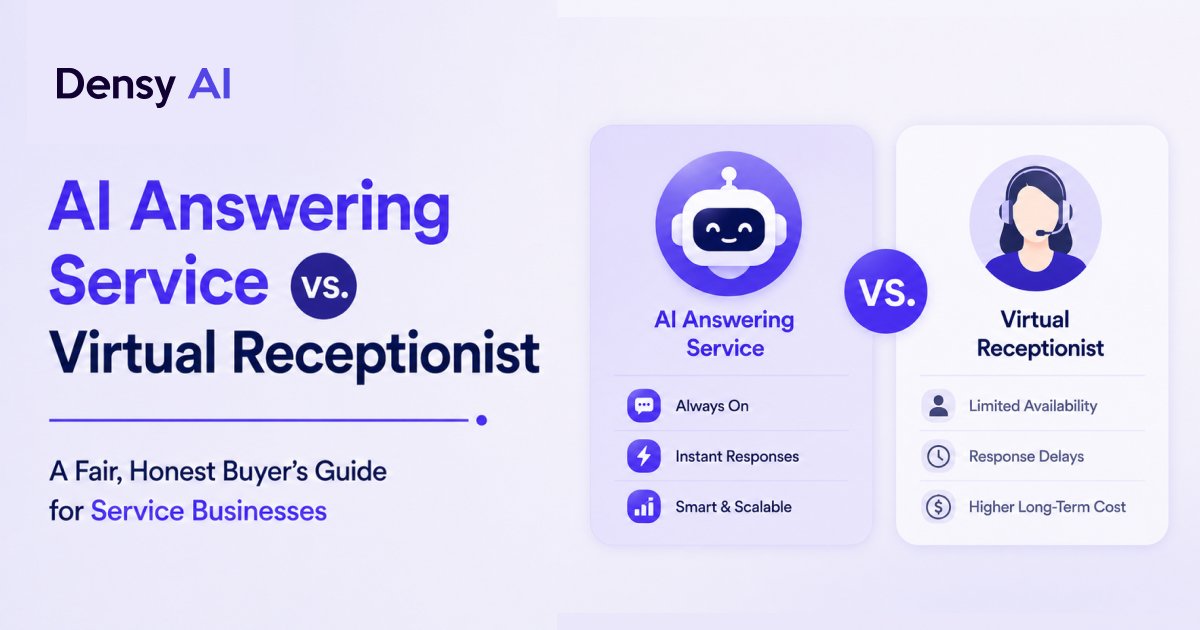
The Core Difference
An AI answering service uses conversational AI to answer your inbound calls automatically, 24 hours a day, at a flat monthly cost. Every call is handled by software that has been configured for your business — your greeting, your intake questions, your booking rules, your escalation criteria. There is no human on the other end of the phone.
A virtual receptionist service uses live human agents who answer calls on your behalf during their working hours, typically billed per minute of agent time. A trained receptionist picks up, identifies your business, and handles the call the way you have trained them to. Most virtual receptionist services operate during US business hours; some offer extended coverage at higher tiers.
Both categories will answer a phone when you cannot. The similarity ends there.
Head-to-Head: Where They Differ
Six dimensions matter in practice.
Coverage hours. AI answering services are always 24/7. Virtual receptionists typically cover US business hours; extended or 24/7 coverage is offered at a premium tier. If a meaningful percentage of your calls come in after hours (they do for most service businesses — 30–40% of calls typically fall outside 9–5), this difference dominates the buying decision.
Pricing model. AI answering services are almost universally flat monthly subscription. Virtual receptionist services are almost universally per-minute or per-call. At meaningful call volume (over 200 calls a month), the per-minute model becomes significantly more expensive. At very low call volume (under 50 calls a month), it can be cheaper because you are only paying for the minutes you use.
Consistency. AI answering services deliver the exact same experience on every call — same greeting, same intake questions, same voice, same intake speed. Virtual receptionist experiences vary by which agent picks up. Some agents are excellent; some are new. Some are having a good day; some are not. This variance is not a critique of the receptionists — it is inherent to any human-driven service.
Concurrent calls. AI answering services handle unlimited simultaneous calls. Virtual receptionist services are bottlenecked by how many agents are on shift. During peak volume, virtual receptionists route to voicemail or make callers hold.
Appointment booking. Modern AI answering services book directly into your calendar, PMS, DMS, or industry system during the call, with immediate SMS and email confirmation. Most virtual receptionist services either book indirectly (a follow-up text or email) or refer the caller back to you for scheduling. The exception is virtual receptionist services with direct calendar integration, which are a shrinking minority.
Warmth on complex situations. This is where virtual receptionists still win. An angry customer, a bereavement call, a genuine emergency, a caller who needs empathy over information — a well-trained human agent handles these better than any current AI. A well-designed AI answering service escalates these to a human on your team; virtual receptionists handle them directly.
Which Should You Actually Pick?
Three simple rules cover most decisions.
Pick an AI answering service if you receive more than 100 inbound calls a month, a meaningful percentage come in after hours, appointment booking directly into your system matters, and you want predictable monthly cost regardless of call volume. Most service businesses fit this profile. If this describes you, see how Densy AI works as an AI phone answering service or a full AI receptionist.
Pick a virtual receptionist if you receive fewer than 50 inbound calls a month, callers highly value a warm human first impression, and you do not have the appetite to configure an AI system for your business. Some categories — high-end professional services with low call volume, boutique legal firms — genuinely fit this profile.
Pick a hybrid AI + human service if you specifically want a human on every call but also want AI for after-hours coverage. Smith.ai is the best-known vendor in this category. Hybrid services split the difference on cost and coverage — they are rarely the cheapest option or the most consistent, but they can be a defensible middle ground. See our full Densy AI vs Smith.ai comparison for the tradeoffs.
The Common Buying Mistakes
Two mistakes come up most often in this decision.
Mistake one: assuming AI answering services all sound robotic. The AI voice quality gap has closed dramatically over the last 18 months. Top-tier AI answering services now use natural-language voice models that most callers cannot distinguish from a human. Lower-tier services still sound synthetic. Do not assume — test. Ask any AI answering service vendor to place a real call to you before signing anything.
Mistake two: assuming a virtual receptionist means real 24/7 coverage. Most virtual receptionist services default to US business hours. 24/7 coverage exists but at a premium tier that significantly changes the cost calculation. Read the pricing tiers carefully — the “24/7” language on marketing pages often refers to the top plan, not the entry plan you were quoting.
Frequently Asked Questions
What is the difference between an AI answering service and a virtual receptionist?
An AI answering service uses conversational AI to answer inbound calls automatically 24/7, at a flat monthly cost. A virtual receptionist service uses live human agents who answer calls on your behalf during their working hours, typically billed per minute of agent time. AI answering services are consistent, always available, and cheaper at scale. Virtual receptionists are warmer on the first impression, better at complex judgment calls, and require little configuration.
Which is cheaper — an AI answering service or a virtual receptionist?
An AI answering service is almost always cheaper at meaningful call volume because it avoids the fully-loaded cost of human agents. Virtual receptionist services typically bill per minute at rates from $1 to $3 per agent minute, which adds up quickly for businesses receiving more than 200 calls a month. Flat-rate AI answering services do not scale with call volume the same way.
Do AI answering services sound robotic?
Modern AI answering services use natural-language voice models that most callers cannot distinguish from a human. The caveat is that quality varies significantly between vendors — early or lower-tier AI answering services do sound robotic, and this is worth testing directly during a demo. Ask the vendor to place a real call to you as part of the sales process.
Can a virtual receptionist book appointments the same way an AI can?
A live virtual receptionist can book appointments by looking at your calendar during the call, but only if they have live access to your booking system. Most virtual receptionist services require a follow-up email or text to confirm the booking. Modern AI answering services book directly into the calendar or industry system during the call, with immediate SMS and email confirmation.
Which should a small business pick?
For most small service businesses receiving more than 100 inbound calls a month, an AI answering service wins on cost, coverage, and consistency. For very low call volume businesses that receive fewer than 50 calls a month and highly value a human voice, a virtual receptionist can still be the right pick — the total cost is manageable at that volume and the human touch matters more than cost efficiency.
What about a hybrid AI + human answering service?
Some vendors (notably Smith.ai) offer hybrid AI + live human agents — AI handles simple calls and humans handle complex ones. Hybrid services split the difference on cost but rarely match the pure AI cost curve at scale, and they add complexity around when calls route to humans versus AI. For most service businesses, pure AI or pure human is a cleaner buying decision than hybrid.
See what an AI answering service costs and does for your business
Densy AI is an AI answering service and AI receptionist built for US service businesses. Book a free 30-minute demo and see it configured for your industry, your call volume, and your existing systems.