
How Much Do Missed Calls Cost Your Business?
The Numbers Are Worse Than You Think
Most small business owners know they miss calls. Few know the dollar amount sitting behind that missed call notification. Here is exactly how to calculate what it is costing your business — and what to do about it.
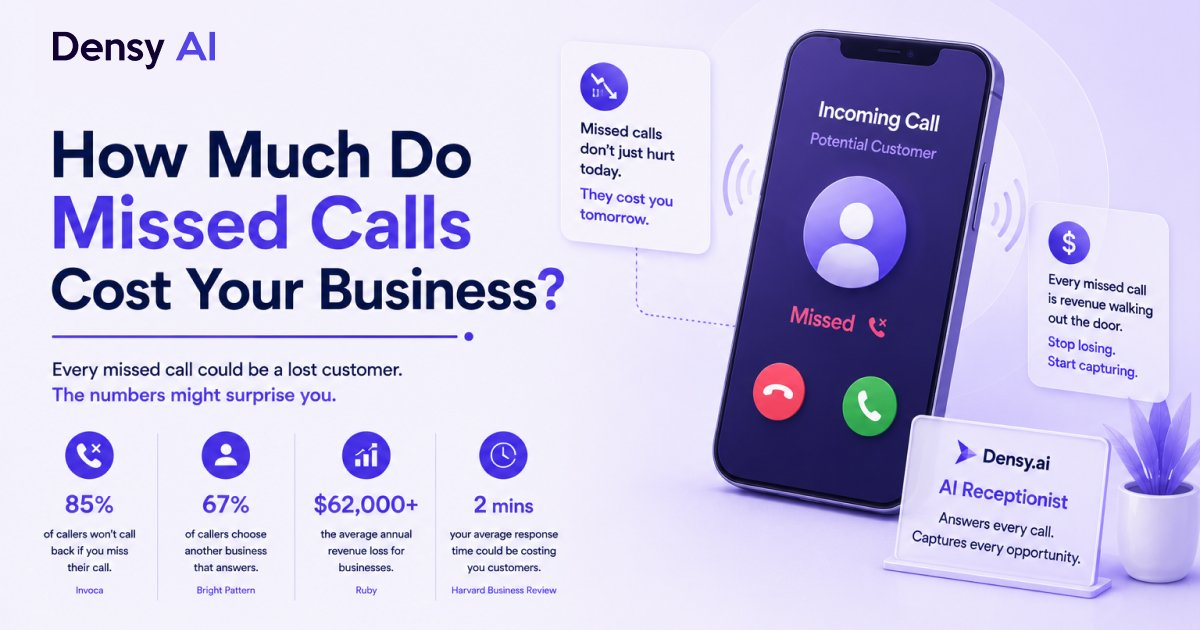
The Missed Call Problem Nobody Talks About
A bad review shows up online. An angry customer sends an email. A billing dispute lands in your inbox. These problems are visible — you know they happened and you can respond. A missed call is different. It disappears the instant it hits voicemail. No notification tells you a prospect just chose your competitor. No entry in your CRM notes the lead that never became a customer. The damage is entirely invisible.
This invisibility is what makes missed calls so expensive. They do not show up on any report. They do not trigger any alert. They do not cause a single complaint. They just quietly drain revenue, week after week, while the business owner focuses on the problems they can actually see. The prospect who could not reach you on a Tuesday afternoon is not filing a complaint — they are already on the phone with the business that answered.
For most small service businesses, missed calls are not an edge-case annoyance. They are a structural leak — one that grows proportionally with call volume, with business hours gaps, and with how busy the team gets during peak periods. The first step to fixing it is understanding the true scale of the problem.
The Statistics — How Many Calls Actually Go Unanswered
Industry research consistently shows the same pattern across service businesses of all sizes: a substantial portion of inbound calls never connect to a human. The numbers below are drawn from studies of call volumes and outcomes across small and medium-sized service businesses in the United States.
The 62% figure is the one that surprises most business owners. Nearly two out of three calls going unanswered feels impossible — until you account for lunchtime, after-hours calls, peak-volume periods when all lines are busy, and the simple reality that most small businesses are run by people who are doing the actual work, not sitting by the phone.
The 85% voicemail abandonment rate reflects a shift in consumer behaviour over the past decade. Leaving a voicemail requires effort and a willingness to wait — two things modern buyers are increasingly unwilling to offer a business they have never used before. The comparison shopping dynamic compounds this: with multiple competing businesses a Google search away, the path of least resistance is simply to call the next result.
The $126,000 figure is calculated from the average inbound call volume for a small service business (roughly 500 calls/month), a 30% miss rate (150 missed calls), a 20% would-have-converted rate (30 customers), and an average transaction value of $350. At 12 months, that is $126,000 in potential annual revenue that never materialized.
How to Calculate Your Own Missed Call Revenue Loss
The $126,000 average is useful for context. Your actual number depends on your call volume, your miss rate, your conversion rate, and the value of your typical customer. Here is a simple formula you can run in under two minutes.
The Missed Call Revenue Formula
Fill in your own numbers:
- 1Monthly inbound calls. Check your phone system or ask your front desk for a rough estimate. Most small service businesses receive 200–800 calls per month.
- 2Miss rate. If you do not have exact data, use 30% as your baseline — that is the industry average for businesses without dedicated answering coverage. If you operate after-hours gaps, use 40%.
- 3Conversion rate on answered calls. What percentage of people who call and connect actually become customers? For most service businesses, this is 20–35%. Use your best estimate.
- 4Average customer value. Use the average first-transaction value, not lifetime — this calculation is conservative by design.
- 5Multiply by 12. This gives your annualised revenue loss figure.
Example: Dental Clinic
500 calls/month × 30% miss rate = 150 missed calls. 150 × 25% conversion = 37 patients who would have booked. 37 × $800 average first visit = $29,600/month in potential revenue. Annualised: $355,200 per year — before accounting for lifetime patient value, referrals, or treatment plans.
Run the same formula with your numbers. Most business owners who go through this exercise for the first time are surprised by the result. The reason is simple: the cost of a missed call is invisible in the moment but compounds relentlessly over time.
Why Callers Don't Leave Voicemails — And Don't Call Back
The assumption behind most small business phone strategies is that a missed call results in a voicemail, and a voicemail results in a callback. The data does not support this assumption.
Only 15% of callers will leave a voicemail for a business they have never interacted with. Among callers under 40 — the demographic driving most purchasing decisions in service categories — that figure drops closer to 10%. Voicemail has become associated with friction and delay. The implicit contract it used to carry — “leave a message and I will call you back” — has been replaced by an expectation that communication should be immediate, or at minimum, fast enough that exploring alternatives is not worth the wait.
The mechanics of modern comparison shopping amplify this. When a homeowner needs a plumber, they search, get a list of options, and call the first one. If that call goes to voicemail, the effort required to leave a message and wait is greater than the effort required to call the second result. There is no loyalty at that stage — just convenience. The business that answers wins the job. The one that does not, usually does not get a second chance.
78% of callers who can't reach a business will call a competitor instead of waiting for a callback. The window to recover a missed call closes within minutes, not hours.
The Industries Hit Hardest by Missed Calls
Every service business loses revenue to missed calls. But certain industries are particularly vulnerable — either because their average customer value is high, because their leads are ultra time-sensitive, or because competitors are just one search result away.
Dental Clinics
Dental practices miss 35–40% of inbound calls. Each missed new patient inquiry represents $800–$2,500 in lifetime patient value. A 500-call-per-month practice missing 30% at a 25% conversion rate is leaving over $360,000 per year on the table.
See industry details →Insurance Agencies
Insurance is the most speed-sensitive category of all. Research shows a lead is 21 times more likely to convert if contacted within 5 minutes versus 30. An agency missing 37% of inbound calls is handing policies directly to the first agent who picks up the phone.
See industry details →Home Services
Plumbers, HVAC technicians, and roofers miss calls at the worst possible moments — while on a job, after hours, or during a weather-driven surge. Emergency calls carry a 3–5x premium over standard bookings. Missing them means losing both the job and a potential long-term customer.
See industry details →Legal Firms
A potential client calling a law firm has already decided they need legal help. They are calling to find out if they'll use you or someone else. An unanswered call — or a slow callback — typically ends with the next firm on their list getting the case.
See industry details →How to Stop Losing Revenue to Missed Calls
There are three broadly available approaches. Understanding the trade-offs is important because the right one depends entirely on your business size, call volume, and budget.
Option 1: Hire additional front-desk staff
A full-time receptionist costs $35,000–$55,000 per year in salary before benefits, paid leave, and the inevitable turnover cycle. That covers roughly 40 hours per week — leaving your phone unprotected for the other 128 hours, including every evening, weekend, and holiday when high-intent callers are still shopping. Scaling this approach to cover all coverage gaps requires multiple hires. For most small businesses, the economics do not work.
Option 2: Use a traditional answering service
Human answering services charge on a per-minute or per-call basis. They cover the phone but have meaningful limitations: agents are reading scripts, not your CRM; they cannot book appointments into your calendar in real time; and the per-minute model means costs scale rapidly with call volume. Service quality is also inconsistent — you get whoever is staffed that shift.
Option 3: AI-powered call answering and missed call recovery
AI answering services like Densy AI answer every inbound call within two rings, 24 hours a day — qualifying leads, booking appointments, and routing calls according to rules you define. For calls that still slip through, automated missed call recovery fires a personalised text within seconds of the missed call, re-engaging the caller before they reach your competitor.
The cost difference is significant. A full-time AI AI receptionist starts at a fraction of what a single part-time hire costs — and it covers 24 hours, handles unlimited simultaneous calls, never takes sick days, and logs every interaction to your CRM automatically. For service businesses where each incoming call represents hundreds or thousands of dollars in potential revenue, the ROI calculation is straightforward.
The fastest path to fixing missed call revenue loss: implement automated missed call recovery first (setup takes hours, not days), then layer in 24/7 AI answering to prevent the miss from happening in the first place. Most businesses recover their setup cost within the first week of operation.
Frequently Asked Questions
How many calls does the average small business miss per day?
Research consistently shows that 30–40% of inbound calls to small service businesses go unanswered. For a business receiving 20 calls per day, that is 6–8 missed opportunities every single day — roughly 180–240 per month.
What percentage of callers leave a voicemail when they reach a small business?
Only about 15% of callers will leave a voicemail when they reach one at a small business. The remaining 85% simply hang up. Of those, more than three quarters will call a competitor next rather than waiting for a callback.
How much does a single missed call cost a small business?
It depends entirely on your average customer value and conversion rate. A plumber missing a call that would have become a $600 job loses $600 (minus costs). A dental clinic missing a new patient call loses $800–$2,500 in lifetime patient value. Multiplied across the average SMB miss rate, this adds up to over $100,000 per year for most service businesses.
What is the fastest way to fix missed call revenue loss?
The fastest fix is automated missed call recovery — software that detects a missed call and sends an immediate text back to the caller within seconds. This re-engages the prospect before they call a competitor. Combined with a 24/7 AI answering service that answers calls in the first place, most businesses eliminate the problem entirely within 48 hours of setup.
Does missed call recovery software actually work?
Yes. Businesses using automated missed call recovery typically recover 40–60% of callers who would otherwise have gone cold. The key is speed — the follow-up text needs to arrive within seconds of the missed call, not hours later. Callers who receive an immediate response are far more likely to engage than those contacted the next day.
Ready to fix it?
Stop Losing Revenue to Missed Calls
Densy AI answers every call within two rings, 24 hours a day — and automatically follows up on any that slip through within seconds. See exactly how it would work for your business.
No commitment required. Live in 24–48 hours.