
Why Home Service Businesses Lose 27% of Their Jobs
Before They Even Start
You're on a job. Your phone rings. You can't answer — you're under a sink, on a rooftop, or mid-conversation with a client. By the time you're free, that caller has already booked your competitor. This happens to home service businesses 27–40% of the time. Here is what it is costing you and how to stop it.
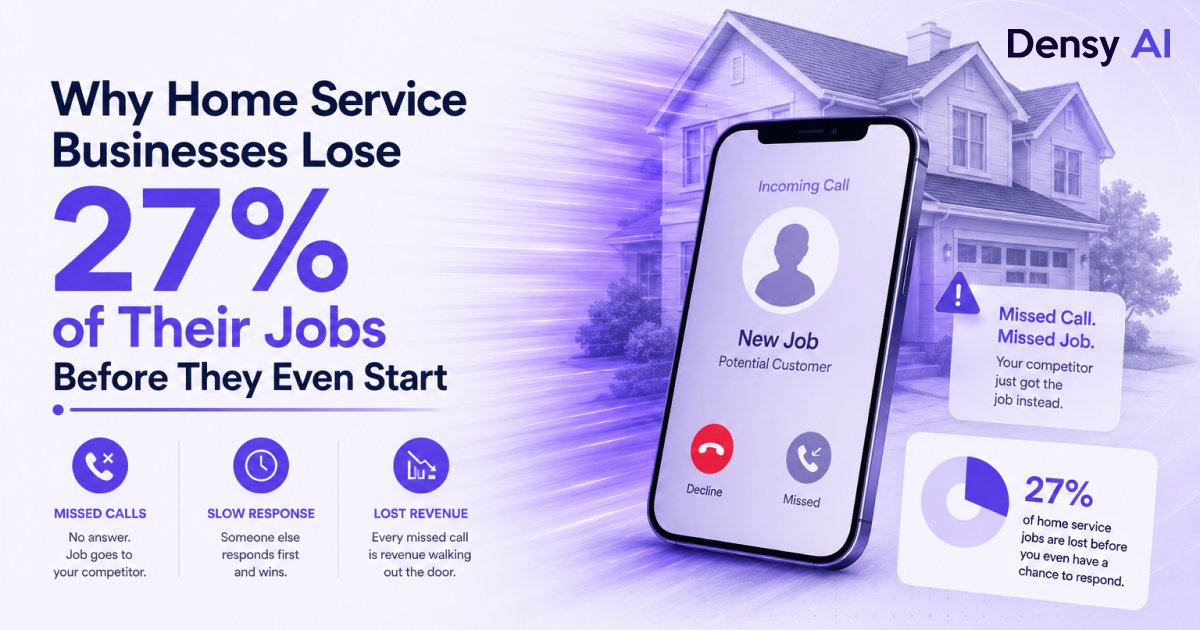
The Call You Missed While on the Job Just Went to Your Competitor
Here is the scenario. You are knee-deep in a repair. Your phone buzzes in your pocket. You cannot answer it — not safely, not professionally, not without stopping everything. By the time you get to it, the screen shows a missed call. No voicemail. You try calling back five minutes later. No answer. That homeowner is already talking to the next plumber on the list — the one who picked up.
This is not a rare edge case. For most home service businesses — plumbers, HVAC technicians, electricians, roofers, landscapers — this is the daily reality. The work is physically demanding and requires full attention. Being unreachable is not a choice or a personal failure. It is a structural feature of the job. The problem is that the homeowner calling you does not know that, and does not care. They need someone now, and someone is available. Just not you.
The result is a miss rate between 27% and 40% — the highest of any service industry. Every one of those missed calls is a job that went somewhere else, a customer relationship that never started, and revenue that does not appear on any report. It is invisible damage, and most contractors do not know how much it is costing them until they run the numbers. The numbers are usually a shock.
How Much Is Each Missed Call Actually Worth?
The cost of a missed call depends entirely on your trade. A landscaper missing a seasonal enquiry and an HVAC tech missing an emergency system-failure call are in completely different revenue categories. What they share is the same outcome: a caller who does not reach you moves on immediately. Below is the data across the four highest-volume home service trades.
Here is the cost breakdown by trade — using conservative estimates for call volume (200 calls/month), miss rate (30%), and conversion rate on answered calls (25%):
Plumber
Emergency plumbing calls carry a 2–3× premium over standard bookings. A homeowner with a burst pipe at 11pm is not comparison shopping — they are booking whoever answers. Miss that call and you lose both the emergency job and any chance of an ongoing relationship with that household.
Est. annual revenue loss: ~$108k — (200 calls/mo × 30% miss × 25% convert × $600 avg)HVAC
The hottest day of summer and the coldest night of winter generate your highest-value calls. Every tech is deployed, the phone rings constantly, and every unanswered call goes to a competitor. A single missed system-replacement conversation can represent $5,000–$8,000 in lost revenue.
Est. annual revenue loss: ~$216k — (200 calls/mo × 30% miss × 25% convert × $1,200 avg)Electrician
Electrical emergencies — panel failures, sparking outlets, loss of power — come with both urgency and high ticket values. Electricians who answer these calls build the residential client base that generates steady referral revenue. Missing them means losing the relationship, not just the single job.
Est. annual revenue loss: ~$144k — (200 calls/mo × 30% miss × 25% convert × $800 avg)Landscaper
Landscaping enquiries are often seasonal-contract opportunities, not one-off jobs. A missed call in March from a homeowner asking about spring cleanup is frequently the start of a $4,000–$8,000 annual maintenance contract. Missing that call means losing every invoice in that contract, not just the first one.
Est. annual revenue loss: ~$72k — (200 calls/mo × 30% miss × 25% convert × $400 avg)These estimates are conservative by design. They use a 25% conversion rate and first-job value only — they do not account for repeat customers, referrals, or ongoing service contracts. The actual cost of a missed call is almost always higher than the single-job calculation suggests.
For the full framework on calculating missed call revenue loss — including the exact formula and worked examples across industries — read: How Much Do Missed Calls Cost Your Business?
Why Home Service Businesses Miss More Calls Than Any Other Industry
Office-based businesses have a front desk. Retail businesses have staff on the floor. Home service businesses have technicians on job sites — which means the person best placed to answer the phone is the person least able to answer it. This structural gap is the primary driver behind the industry's above-average miss rate, and it is not a problem that resolves itself by trying harder.
The problem compounds during the periods when call volume is highest. A heat wave means every HVAC tech is deployed. A heavy storm means every roofer and plumber is stretched. A public holiday weekend means reduced capacity against a backlog of homeowners who have been putting off a repair. These surge periods are when the most high-value calls come in — and they are exactly when the capacity to answer them is lowest. A business misses proportionally more calls as it gets busier, which is the opposite of what growth should look like.
There is also the hours problem. Homeowners discover problems in the evening — they come home from work and find the basement flooded, the boiler not firing, the lights flickering. Calls that arrive after 6pm are among the highest-intent calls a home service business will receive. They come from homeowners with an active, urgent problem and no patience for voicemail. If your phone goes unattended after hours, you are unreachable precisely when your callers are most ready to book — and most willing to pay emergency rates.
The 85% Rule — Why Voicemail Doesn't Save the Lead
Most contractors assume that a missed call is not permanently lost — that the homeowner will leave a voicemail, and a callback will close the job. This assumption is wrong, and the data is consistent on the point across every service industry studied.
85% of callers who reach a voicemail at a service business do not leave a message. They hang up and move on. Among callers under 40 — the demographic that makes up the majority of new homeowners — the figure is even higher. Voicemail has become associated with delay and effort, neither of which a homeowner with an urgent repair is willing to accept. The implicit promise of voicemail — "leave a message and I will call you back" — requires trust that a first-time caller has not had the chance to build. Absent that trust, the path of least resistance is the next contractor on the list.
The 60-second window makes this worse. Research consistently shows that the average homeowner waits less than 60 seconds before dialling the next number. In an emergency — a burst pipe in winter, a broken AC in summer — that window is even shorter. A callback twenty minutes later, or the next morning, does not recover the lead. The job is already booked. The homeowner has moved on. The only window that matters is the one that closes while the phone is still ringing.
A voicemail system is not a lead-capture tool for home service businesses. It is a place where 85% of your missed leads quietly disappear — uncontested, and never recovered. The only reliable fix is to stop the miss from happening in the first place, or to respond to it fast enough that the homeowner has not had time to dial the next number.
Five Ways to Stop Losing Jobs to Missed Calls
Not every solution fits every business. Here are five approaches, ordered from fastest to implement to most comprehensive — so you can start with what fits your situation today and build from there.
- 01Send an automatic text-back the instant a call is missed
The fastest first line of defence: automated missed call text-back fires within seconds of any unanswered call. The homeowner gets a message while they're still holding their phone — before they've dialled the next contractor. This one change alone recovers 40–60% of calls that would otherwise go cold permanently. It is the lowest-effort, highest-impact first step available.
- 02Cover the after-hours window where your busiest callers are
Homeowners call about a broken furnace at 9pm, not 9am. They notice the leaking pipe on a Sunday morning. If your phone coverage ends when your workday does, you are unreachable during the highest-intent calling window. An after-hours answering layer captures the jobs your competitors are sleeping through — and in emergency trades, those are often your highest-value jobs.
- 03Stop sending surge calls to voicemail
During a heat wave, a storm, or a holiday weekend, every tech is deployed and the phone rings non-stop. This is when you lose the most revenue in the least visible way. A dedicated overflow answering layer — activated automatically when your lines are busy — captures every surge-period call that would otherwise hit voicemail and disappear into the 85%.
- 04Book the job on the first call — not on a callback
Every step that requires the homeowner to wait increases the chance they book with someone else. If your first-call process is to take a number and call back later, you are giving your competitor a window. The fix is to collect job details, confirm your availability, and give a booking commitment on the first call — even when that call is handled by AI on your behalf.
- 05Deploy 24/7 AI answering so every call is answered within two rings
The complete solution is a 24/7 AI answering service that answers every inbound call in your business's name, collects the caller's details, triages the urgency, and either books the job or queues it for your callback. You stay focused on the work in front of you. Every lead is captured. Nothing goes to voicemail. Your miss rate goes from 27–40% to effectively zero.
How Automation Means You Never Miss a Lead Again
The complete solution to the missed call problem is automation — specifically, an AI answering service that handles every inbound call in your business's name, regardless of whether you are available. AI phone answering works by sitting between your phone number and your team. When a call comes in, the AI answers within two rings, identifies itself with your business name and a professional greeting, collects the caller's details and job description, and either books the appointment into your schedule or queues the lead for your callback with a full summary of the conversation.
For calls that do slip through — high-volume surges, simultaneous inbound calls, any rare technical gap — missed call recovery automation fires a personalised text back to the caller within seconds. The message is immediate, professional, and specific to your business — not a generic auto-reply. It re-engages the homeowner before they have had time to reach the next contractor. For home service businesses, this combination — AI answering plus instant missed call recovery — closes the structural gap that has been draining revenue since the day the business started.
The economics make sense at almost any job value. A full AI receptionist costs a fraction of a part-time human hire, operates 24 hours a day, handles unlimited simultaneous calls, never takes sick days, and logs every interaction to your CRM automatically. For a business where a single recovered emergency call covers weeks of subscription cost, the ROI is immediate. Most home service businesses see payback within their first week of operation — often on the first call the AI recovers that would otherwise have gone to a competitor.
Stop losing jobs to missed calls: see how Densy AI handles inbound calls and missed call recovery for home service businesses — and book a free demo to see the exact workflow for your trade.
Frequently Asked Questions
Why do home service businesses miss so many calls?
Home service businesses miss more calls than almost any other industry because the work is physically demanding and hands-on. A plumber under a sink, an HVAC tech on a rooftop, or an electrician in a panel box cannot answer a call. Add surge periods — storms, extreme heat, holiday weekends — when every technician is deployed and the phone rings constantly, and the miss rate climbs well above the industry average of 27–40%.
How much revenue do contractors lose to missed calls per year?
It depends on trade and call volume. A plumber receiving 200 calls per month and missing 30% loses roughly 60 calls. At a 25% conversion rate and $600 average job value, that is 15 jobs × $600 = $9,000 per month, or $108,000 per year — just from the miss rate alone. HVAC businesses with higher average job values lose proportionally more.
What is the 85% rule for voicemails?
85% of callers who reach a voicemail at a service business do not leave a message and do not call back. They move on immediately — usually to the next business in their search results. For home service businesses, this means a voicemail system is not a safety net for missed calls. It is essentially the same outcome as not being reachable at all.
How quickly do homeowners call another contractor after a missed call?
Research shows the average homeowner waits less than 60 seconds before calling the next contractor on their list. In emergency situations — a burst pipe, a broken furnace in winter, a failed AC unit in summer — that window is even shorter. Speed of response is the single most important factor in winning a home service job from an inbound call.
What is the fastest way to stop losing jobs to missed calls?
The fastest first step is automated missed call text-back — software that detects a missed call and sends a personalised text to the caller within seconds. This re-engages the prospect before they reach your competitor. For complete coverage, a 24/7 AI answering service eliminates missed calls at the source by answering every call within two rings, regardless of whether you or your team are available.
Does AI answering work for tradespeople who are on the job all day?
Yes — AI answering is specifically designed for exactly this scenario. The AI answers with your business name, collects the caller's details and job description, confirms availability, and either books the appointment or queues the call for your callback when you're free. You get a full summary of every call handled. You stay focused on the job you're on, and the new lead is captured.
Stop losing jobs to missed calls
See How Densy AI Works for Home Service Businesses
Densy AI answers every call within two rings — while you are on the job, after hours, and during your busiest surge periods. Book a free demo and see exactly how it captures the leads your competitors are currently winning.
No commitment required. Live in 24–48 hours.