
Missed Call Text Back —
How It Works and Why It Recovers More Leads Than a Callback
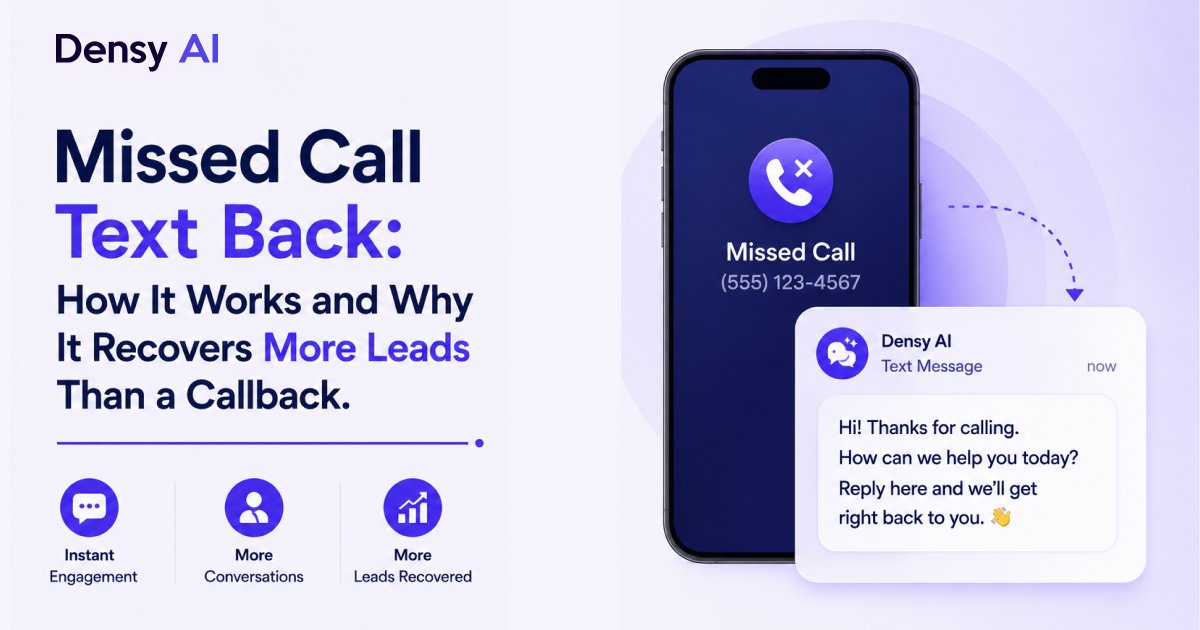
Someone calls your business. You can't answer. They hang up. What happens next depends entirely on whether you have a missed call text back system. Without one: 85% of those callers are gone permanently. With one: an automatic text reaches them within 60 seconds — and 30–60% of those conversations turn into booked appointments.
What Happens When You Miss a Call
Someone calls your business. You don't answer — you are with a customer, it is after hours, the line is busy. They hang up. What happens next?
Without a missed call text back system: nothing. 85% of callers who reach voicemail do not leave a message, according to call tracking data across small service businesses. They either call a competitor immediately or they do not book at all. The lead evaporates before you even know it existed.
With a missed call text back system: within 30–60 seconds of the call dropping, they receive a text message from your business number. They got something. The conversation is open. They can reply when it is convenient — instead of sitting on hold or waiting for a callback that may arrive at the wrong moment. Businesses that implement this consistently report converting 30–60% of previously missed calls into booked appointments or sales conversations. The businesses that do not get 0%. The revenue cost of that gap compounds quickly.
How Missed Call Text Back Works
The mechanism is straightforward. Here is the exact sequence from the moment a call goes unanswered to the moment the lead is recovered.
- 01An inbound call hits your business number
The caller dials your number as normal. Nothing is different on their end — they have no idea what is about to happen differently compared to a standard missed call.
- 02The call goes unanswered
You are on a job, with another customer, or simply not available. The call rings out, hits voicemail, or the caller hangs up before you can answer. This is the moment the lead would normally be lost.
- 03The system detects the missed call in real time
Your missed call text back platform monitors your phone system or VoIP provider and detects the unanswered call the moment it ends. No manual step required — detection is automatic.
- 04An automated SMS goes out within 30–90 seconds
A personalised text fires to the caller's number from your business. The caller is still holding their phone. The message lands while the context of why they called is still fresh — before they have had time to dial the next business on their list.
- 05A two-way conversation opens — and the lead is recovered
When the caller replies, the conversation is handled by AI or routed to a team member. The AI can answer questions, collect job details, and book an appointment in the same thread — converting a lost call into a confirmed booking without any manual involvement.
Multi-step follow-up sequences are standard on purpose-built platforms. If the caller does not respond to the first text within a few hours, a second message goes out. If they still do not respond, a third goes the next day. The sequence stops the moment they reply — ensuring persistent recovery without pestering someone who has genuinely moved on.
Why Text Works Better Than a Callback
This is the part most businesses underestimate. When someone misses a call from an unknown number and then gets a callback 45 minutes later, they often do not answer. They do not know who it is. The moment has passed.
When they get a text from your business number within a minute of their call, they are still holding their phone. They know exactly what the text is about. The context is fresh. Replying takes two seconds. The lead has not cooled — the conversation simply moved to a different channel.
Text also removes the friction that callbacks create: no waiting on hold, no playing phone tag across schedules, no needing to call from a quiet place, no interrupting whatever the caller is doing. The conversation happens at their pace — which means they are more likely to engage with it. For callers under 45, this is not just a preference. It is how they expect to communicate with businesses.
The comparison to a standard missed call recovery callback is stark: a human calling back 20–30 minutes later faces a contact rate a fraction of what an immediate text achieves. Speed is the variable that separates a recovered lead from a lost one — and a text can be immediate in a way that a human callback never can be.
Industries Where It Makes the Biggest Difference
Missed call text back delivers the highest ROI in industries where the miss rate is structurally high, the decision window is short, and each converted lead has meaningful value. The four categories below consistently see the fastest payback.
Home Service Businesses
Plumbers, HVAC technicians, and electricians cannot answer calls while working. A missed call text back captures every lead that comes in while you are on-site — collecting job details, triaging urgency, and booking the appointment so nothing is lost to voicemail.
See industry details →Dental & Medical Clinics
Front desk staff managing check-ins, phones, and admin simultaneously miss calls regularly. A missed call text back routes those callers to online booking — often completing the appointment without any staff involvement.
See industry details →Insurance Agencies
Lead response time determines close rate in insurance. An immediate text after a missed call establishes contact and keeps the lead in your pipeline — before the next agency on their comparison list picks up.
See industry details →Real Estate
Listing enquiries arrive at all hours. A missed call text back at 9pm on a Friday recovers leads that would otherwise be cold by Monday morning — and establishes your agency as the responsive, attentive option.
See industry details →Automotive service lanes and dealership sales floors also see strong results — technicians miss calls while consulting with customers, and sales floors miss calls during peak floor traffic. An immediate text keeps both pipelines alive without adding headcount. For a full breakdown of what missed calls cost across trades, see our guide to how home service businesses lose revenue before the job even starts.
How to Set Up Missed Call Text Back — 3 Options
There are three ways to implement missed call text back, ranging from a basic stopgap to a fully automated lead recovery system. Here is what each involves and who it suits.
- 01Through your VoIP provider — basic, works as a stopgap
Platforms like RingCentral, Grasshopper, and Google Voice Business offer basic missed call SMS notifications. These send a single message with no reply handling — meaning if the caller responds, no one is managing that conversation. Useful as a starting point, but not a complete solution.
- 02Through a CRM with automation — good if you're already invested in one
HubSpot and GoHighLevel can be configured to fire a text when a missed call is logged. Requires setup time and some technical configuration. The conversation management depends entirely on how well your automation flows are built — most small businesses find this more effort than the payoff justifies.
- 03Through a purpose-built AI communication platform — the complete solution
Platforms like Densy AI handle the entire flow end-to-end: detect missed call → send personalised text → manage the two-way conversation → book the appointment → log everything to CRM. No configuration overhead. The multi-step conversation handling is where the real conversion happens — a single text recovery message converts at roughly 60% the rate of a three-message sequence with a booking link on the third touch.
For most service businesses, Option 3 is the right answer — not because Options 1 and 2 do not work at all, but because the value of missed call text back comes from the conversation that follows the first message, not from the message itself. An AI receptionist that can actually handle the reply, answer questions, and complete a booking in-thread converts at a fundamentally higher rate than a system that fires a text and waits for a human to pick it up.
What the Text Should Say
The first message matters. Too short and it is not helpful. Too long and it is not read. The message should acknowledge the missed call directly, keep the tone warm and human, and make the next step obvious with as little friction as possible.
Service-focused opener
“Hi [Name], this is [Business Name] — sorry we missed your call! We'd love to help. What can we assist you with today?”
Direct-to-booking version
“Hi! This is [Business Name] — we just missed your call. We have availability [today / tomorrow] if you'd like to book directly: [link]. Or just reply here and we'll sort it out.”
Personalisation variables — first name, time of call, the caller's enquiry type if known from a prior interaction — improve reply rates by 15–25% above a generic message. What to avoid: anything that reads like a marketing promotion. The caller knows they called you. Keep it simple, service-focused, and easy to reply to.
For businesses with online booking, including a direct scheduling link in the first message is one of the highest-impact optimisations available. It reduces the number of replies needed to complete the booking from several exchanges to one click — and removes the risk of losing the lead between the first text and the point of conversion.
Measuring Whether It's Working
Three metrics tell you everything you need to know about the performance of your missed call text back system. Track these from day one.
Text delivery rate
What percentage of missed call texts are actually delivered to the recipient? Carrier filtering — particularly for business numbers sending high volumes — can suppress delivery rates below what you expect. Good platforms monitor deliverability automatically and route around filtering issues. If your delivery rate drops below 90%, investigate the platform's number health and sending configuration before blaming message copy or timing.
Reply rate
What percentage of people who receive the text reply to it? A 15–30% reply rate is a typical baseline across service industries. 30–50% is strong. Below 15% means the message itself needs work — usually either the opening line is too generic, the business name is not immediately recognisable, or the ask is unclear. Personalisation and a clear, low-friction next step are the two levers that move this number fastest.
Conversion rate
Of the people who reply, what percentage book an appointment or become a qualified lead? This depends primarily on the quality of the follow-up conversation. An AI-handled conversation that can answer questions, book directly, and route complex cases to a human converts significantly higher than a thread that opens a conversation and waits for a human to take over hours later. The gap between these two approaches is typically 2–3× on conversion rate — which is the difference between recovering one in four leads and recovering one in eight.
Bottom line: missed call text back is one of the highest-ROI things a service business can implement. The setup is quick, the cost is low, and the results are immediate because you are recovering revenue from demand you already generated — just failing to capture. If you are missing more than 5 calls per week, this pays for itself in week one.
Frequently Asked Questions
What is a missed call text back service?
A missed call text back service automatically sends an SMS to any caller your business misses — within 30–90 seconds of the call dropping. The message opens a two-way conversation that can be handled by AI or routed to a human team member. It ensures that callers who do not reach you by phone still receive an immediate, professional response from your business before they have time to call a competitor.
How quickly does the automatic text go out after a missed call?
On platforms like Densy AI, the automated text fires within 30–60 seconds of the missed call. This timing is critical: the caller is still holding their phone, still thinking about their need, and still receptive to a response. After 5 minutes, the chance of re-engaging them drops sharply. After 30 minutes, they have almost certainly moved on to the next business on their list.
What should a missed call text back message say?
The best-performing messages are short, service-focused, and personal. A reliable format: "Hi [Name], this is [Business Name] — sorry we missed your call. How can we help you today?" or a version that includes a direct booking link. Avoid anything that reads like a marketing message or promotional offer. The caller knows they just called you — acknowledge that directly and make it easy for them to get what they needed.
How do I know if missed call text back is worth it for my business?
If you are missing more than 5 calls per week, the maths are simple: at a 30% reply rate and 40% conversion of replies, 5 missed calls per week becomes roughly 3 new conversations per month and 1–2 additional jobs or appointments. For most service businesses, a single recovered job covers weeks or months of subscription cost. The threshold for ROI is low enough that it is worth implementing before you have firm data on your own miss rate.
Can I use missed call text back if I already have voicemail?
Yes — missed call text back is not a replacement for voicemail, it is a supplement. The problem with voicemail alone is that 85% of callers who reach it do not leave a message and do not call back. A missed call text back reaches the caller immediately, before they have moved on, and opens a channel they are far more likely to respond to. Many businesses run both in parallel: the AI fires a text while the call is still going to voicemail.
How do I measure whether my missed call text back is working?
Track three numbers: text delivery rate (what percentage of sent messages are delivered), reply rate (what percentage of recipients respond — 15–30% is baseline, 30–50% is strong), and conversion rate (of people who reply, what percentage book or become a lead). If your reply rate is below 15%, the message copy needs revision. If your conversion rate is low, the follow-up conversation handling needs improvement.
Stop losing leads to missed calls
See How Densy AI Handles Missed Call Recovery
Densy AI fires an automatic text back within 60 seconds of every missed call — then handles the reply, answers questions, and books the appointment in the same thread. Book a free demo and see it working for your business.
No commitment required. Live in 24–48 hours.