
Missed Call Text Back for Home Services —
Stop Losing Jobs While You're on the Job
You're under a sink. Your phone rings. You can't answer it. By the time you're done, the customer already called the next plumber on Google. You lost the job before you even knew you had a shot at it. A missed call text back fires automatically within 60 seconds — keeping the lead alive while you finish the work in front of you.
The Home Services Call Problem
Every trades business has the same structural problem: you cannot answer calls while you are working. And every missed call is a job lead — most of them do not leave a voicemail. They call the next business on the list.
This is not a staffing problem. You cannot hire someone to answer calls while you are under a sink — and a dedicated office manager does not make economic sense at most trades business sizes. It is a systems problem, and the fix is a system that responds the moment a call goes unanswered. The broader data on how home service businesses lose revenue before the job starts shows that 27% of all home service calls go unanswered — representing roughly a quarter of potential revenue that never gets captured.
Why Home Services Businesses Miss So Many Calls
The miss rate in trades businesses is structural — it is built into how the work operates. Understanding the four root causes helps clarify why a text-back system solves it when headcount cannot.
Single operator on-site with no one back at the office
Most small trades businesses are the owner plus a small crew, all working jobs simultaneously. Nobody is back at an office answering phones. Every call that comes in during a job is a call the owner can only return much later — if at all.
No dedicated administrative support
Unlike a dental practice with a front desk, many trades businesses have no administrative staff at all. The owner handles their own calls — when they can. During busy seasons, that means calls go straight to voicemail for hours at a time.
Unpredictable volume spikes
An HVAC company in a July heatwave, a plumber during a cold snap, an electrician during new home construction season — call volume can triple overnight. There is no way to staff for a spike that appears without warning. Calls pile up faster than anyone can handle.
After-hours calls from the most motivated buyers
A burst pipe at 10pm on a Sunday. A boiler that stops working on a cold Thursday night. Emergency callers are often the highest-value customers — urgent problem, immediate need, willing to pay for fast service. They are also the ones most likely to hit voicemail and call a competitor.
What a Missed Call Text Back Does for a Trades Business
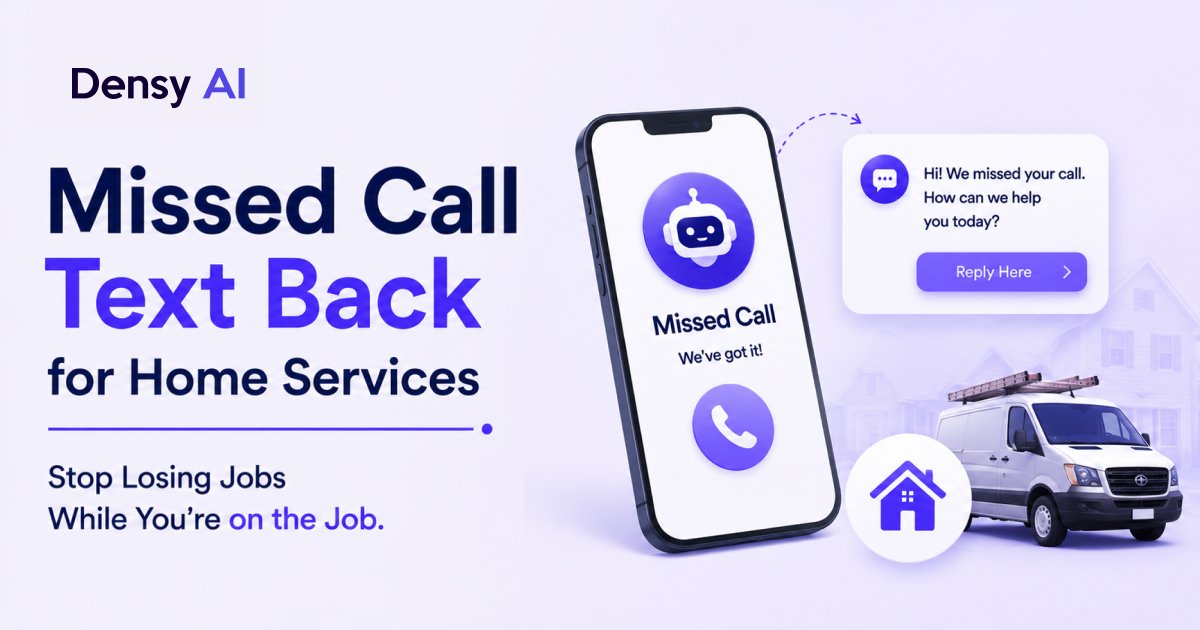
The moment a call goes unanswered, a text fires automatically to the caller's number. The caller is still holding their phone. The message lands while they still have you in mind — before they have had time to dial the next business on the list.
Example first-response message
“Hi! This is Mike's Plumbing — missed your call just now. What's going on? We're usually able to come out same day. Reply here and we'll get right back to you.”
The caller replies. Your AI — or your team, when you are available — picks up the conversation. Job details get collected, availability gets confirmed, and the appointment gets booked. The lead is recovered before they ever hit the second result on Google. Home services businesses consistently report converting 30–50% of callers who would otherwise have been lost. At a 35% conversion rate, a business missing 15 calls per week recovers roughly 5 additional jobs per week. For a full explanation of the mechanism, see the guide to how missed call text back works.
What to Put in Your Auto-Text
For home services, the message needs to communicate three things in under 160 characters — long enough to be credible, short enough to be read immediately.
- 01Who you are
Use your business name. The caller may not recognise your number — especially if you use a business line different from your personal phone. “This is Mike's Plumbing” takes four words and eliminates confusion immediately.
- 02That you are on it — not just available later
“We'll get back to you” sounds like a voicemail. “What's going on?” or “We can usually come out today” signals responsiveness and moves the conversation forward. For emergency services: “If you have a plumbing emergency, text URGENT and we'll prioritise your call” creates an immediate channel for your highest-value callers.
- 03A clear path forward
Reply here, click to book, or a direct callback number. The easier it is for the caller to take the next step, the higher the reply rate. Remove every friction point between their reply and a confirmed booking.
Setting It Up Without Adding Complexity
Most trades businesses do not want another dashboard to manage. There are two setup paths — choose based on how much conversation management your team can realistically handle.
VoIP-based — simple, works as a stopgap
Google Voice Business, RingCentral, and similar providers support missed call SMS configuration in 30 minutes. A single auto-reply message goes out. No conversation management — when the customer replies, the conversation lands in your SMS inbox and your team handles it manually. Better than nothing; not a complete solution.
AI-handled — the complete solution
Platforms like Densy AI handle the full conversation — initial text, two-way SMS, job details collection, scheduling, and CRM log. The AI manages the conversation while you are on a job and hands off anything that needs you directly. For solo operators or small crews where nobody is available to manage inbound SMS replies during work hours, this closes the gap that the VoIP option leaves open.
The Math for a Trades Business
Average job value: $350
Missed calls per week: 15
Text-back conversion rate: 35%
Jobs recovered per week: 15 × 35% = 5.25 additional jobs
Revenue recovered per week: 5.25 × $350 = $1,837
Revenue recovered per month: $7,350
At $350/month for a full AI answering solution — payback is in week one.
These numbers are conservative. The conversion rate improves as the AI learns your business and the message copy is refined. After-hours recovery — which contributes nothing without a text-back system — adds to the total. And the figure above does not include repeat jobs and referrals from the recovered customers, which compound the return further over time. For a full breakdown of missed call revenue impact across service businesses, see the cost of missed calls guide.
The home services industry page covers the full range of AI tools available to trades businesses — including inbound answering, job scheduling, and outbound follow-up for estimate requests that did not convert immediately.
Frequently Asked Questions
How does missed call text back work for a plumber or HVAC business?
When your business misses an inbound call, the system automatically sends an SMS to the caller within 30–60 seconds. The text introduces your business, acknowledges the missed call, and opens a two-way conversation. An AI platform handles that conversation — answering availability questions, collecting job details, and scheduling the visit — without interrupting your current job.
How many leads do home service businesses recover with text back?
Home services businesses report converting 30–50% of previously-missed callers into booked jobs. At a 35% conversion rate, a business missing 15 calls per week recovers roughly 5 additional jobs per week. At $350 average job value, that is over $7,000 per month in recovered revenue — against a $350/month AI solution cost, payback is in week one.
What should a home services missed call text say?
The most effective messages communicate three things: who you are (business name — callers may not recognise your number), that you're on it ("what's going on?" or "we can usually come out today"), and a clear path forward (reply here, click to book, or text URGENT for emergencies). For emergency-capable services, flagging availability in the message increases reply rates significantly.
Is a simple VoIP auto-reply enough or do I need an AI platform?
A VoIP auto-reply sends one text and requires you to handle the conversation manually. That's better than nothing but creates a bottleneck: if you're still on a job when the customer replies, the conversation stalls. An AI platform handles the full conversation — collecting job details, confirming availability, and booking the appointment — without your involvement. For solo operators, that's the difference between a recovered lead and one that goes cold.
Built for trades businesses
Stop Losing Jobs to Missed Calls
Densy AI fires an automatic text within 60 seconds of every missed call, handles the reply conversation, and books the job — while you stay focused on the work in front of you. Book a free demo and see it working for your type of business.
No commitment required. Live in 24–48 hours.